“This is not some placeholder for life. This is it! This is YOUR ONE, OWN, ONLY little life. And you and only you can make it better. Surely you can do that. And I will NOT quit calling you Shirley. So deal with that, too, bucko.”
“Life Sucks.” by Aaron Posner
Though I have started a few other blog posts, my mind always finds its way back to theatre and literature. Isn’t the inspirational advice given in every movie about aspirational writers to “write what you know,” said by a mentor over swelling major key chords composed for the sole purpose of emotional manipulation? And, despite being aware of this manipulation, do we not still wipe tears from our eyes as we consider the great novel that lies within each of us?
Whether a result of pessimism or realism, I strongly doubt the next great novel exists within me. Don’t get me wrong, I do consider myself a writer. I have a bachelor’s degree in English and am the author of a few poetry chapbooks; last month, I successfully defended a 150+ page dissertation I wrote on sociocultural factors impacting employees’ self-perceptions and experiences in the workplace. (Please, attempt to cover your yawn.) None of this work is going to make the New York Times Bestseller list or be recommended by Oprah. Despite how serious my work may sound, however, I approach writing with a certain levity, which brings me to the topic of this post: Great Russian Literature.
I can hear you asking “What exactly is humorous about Russian literature?” Yes, what exactly is humorous about it? (I’m asking you so I can avoid answering the question myself, as much of it is about dysfunctional families, alcoholism, suicide, shame, and death.) Many undoubtedly associate Russian literature with required reading in a high school or college English course. Despite the “required” element, perhaps you turned to CliffsNotes to learn just enough about the book to write a passable essay or answer questions on a pop quiz. As someone who seeks humor in even the most serious topics, when I was required in high school to present on a chapter of Dostoevsky’s The Brothers Karamazov, my group included a Seventeen magazine-style personality quiz entitled “Which Brothers K Character Are You?” Dostoevsky undoubtedly rolled over in his grave from our cavalier approach to his great work.
Speaking of great work, for the theatrically inclined, Anton Chekhov is likely a well-known name. Along with Henrik Ibsen (of Hedda Gabler and A Doll’s House fame), Chekhov is known as being one of the founders of modernism. Despite his death at 44 years of age, Chekhov wrote four plays deemed classics: The Seagull, Three Sisters, The Cherry Orchard, and Uncle Vanya. Additionally, he has been attributed with an important literary and theatrical concept referred to as “Chekhov’s gun,” which remains a critical element of storytelling today. Much like the work of Jonathan Larson (see my previous blog post), modernists like Chekhov wrote about contemporary social, class, and political issues- not exactly uplifting topics when they were written at the end of the 19th century or frankly, even today.
Modern playwright Aaron Posner has gained notoriety for his “sort of adaptations” or variations of novels, short stories, and classical plays, ranging from Shakespeare to Mark Twain. He has re-visioned three Chekhov plays: the play Three Sisters as No Sisters, Uncle Vanya as Life Sucks., and most hilariously, The Seagull as Stupid Fucking Bird. The titles alone provide insight into the humor- and adult language- incorporated into these revisions.
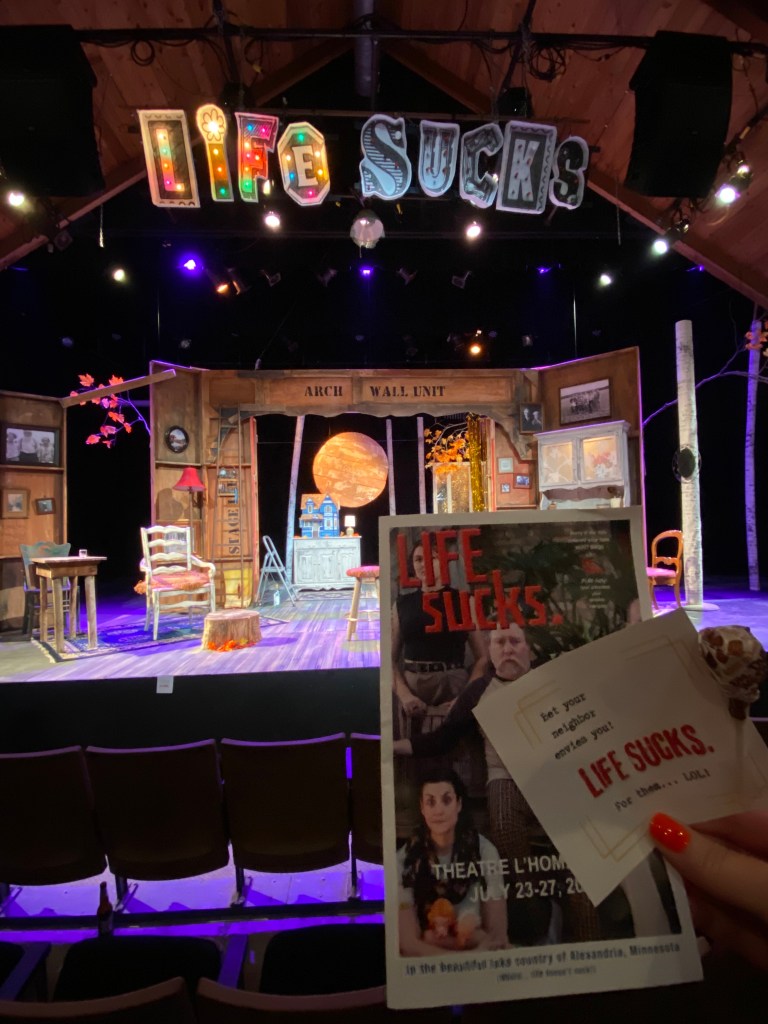
Life Sucks., produced by Open Eye Theatre & Girl Friday Productions at Theatre L’Homme Dieu, July 23-27
I had the pleasure of seeing Life Sucks. on opening night at Theatre L’Homme Dieu. The show came with mature content advisories posted at the theater, printed in the program, and stated in the curtain speech, but the audience seemed to wholeheartedly embrace the show and its plethora of F-bombs and emotional fireworks expertly executed by a diverse cast of characters as each, in their own way, dealt with how much life can suck. Whether unrequited love or the endless search for fulfillment, the characters’ struggles are relatable and simultaneously humorous and heartbreaking.
Circling back to the beginning of this post and “writing what you know,” it is pretty incredible to see the thread woven from Chekhov’s original work through Posner’s adaptation. Despite living on different continents more than 100 years apart, the authors’ intimate understanding of what it means to be human transcends time, distance, and culture. Sitting in an audience full of strangers, I was reminded how truly connected we all are by our humanity and our ability to feel, to fear, to hope, to love, and to mourn.
According to Posner’s character Babs:
“Life is just life. Life is just exactly life, you know that, right? And we should be grateful every day for the great and mysterious gift that it is. And yet… we find the most extraordinary ways to fuck it all up for ourselves. But I don’t think it has to be as hard as we make it, I really don’t.”
We have so many choices in how we live our lives and Life Sucks. reminds us to slow down and remember that life can suck, but it doesn’t always, and it doesn’t have to.
As for me, I am going to strive to take Babs’ advice, and “eat every morsel of life I can before I’m through.”

 SHB Explores
Leave a reply to What’s in a Name? – SHB Explores Cancel reply